


What is Salesforce?
Salesforce is the customer relationship management (CRM) platform that much of the enterprise software industry is now built around. At its core, it stores every customer, account, deal, case and interaction in one shared database, then lets different teams build on top of that same data using point-and-click configuration, custom code, AI features and thousands of pre-built apps.
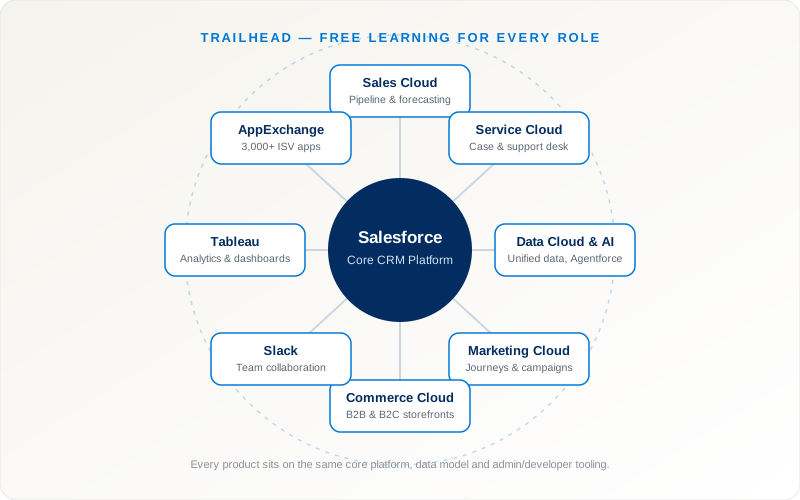
That "one platform, many products" structure is why Salesforce careers split into distinct paths rather than one job title. Someone can spend an entire career configuring the platform, building on it with code, or designing how the pieces fit together — and each of those is a different, well-paid, in-demand job.
The three core Salesforce career paths
| Path | What they actually do | Typical background | Where they sit on a project |
|---|---|---|---|
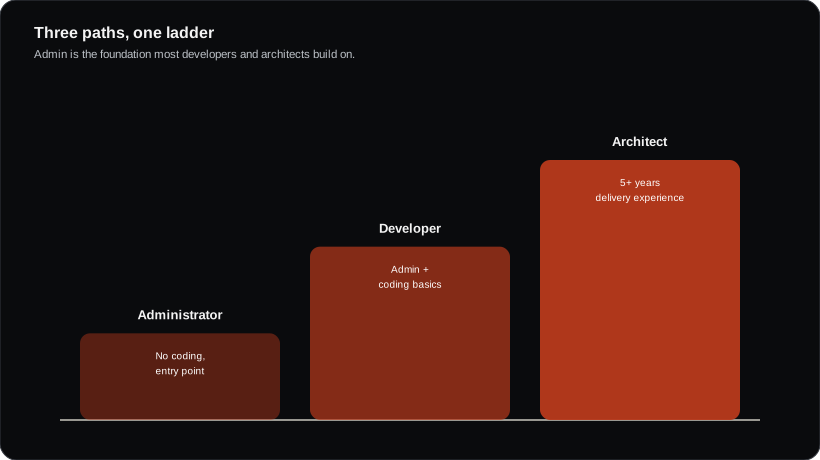
| Administrator | Configure objects, fields, automation (Flow), security, reports and user support without writing code | Business analysis, operations, support, "power user" roots | Runs the org day-to-day; first point of contact for user requests |
| Developer | Builds custom logic with Apex, Lightning Web Components and integrations when configuration alone isn't enough | Software engineering, or admins who learned to code | Implements what the platform can't do out of the box |
| Architect | Designs how objects, integrations, security and multiple clouds fit together across a whole org or programme | Senior admins or developers with years of delivery experience | Sets technical direction and owns the trade-off decisions |
Consultants and Business Analysts sit alongside these three, usually as admins or architects who specialise in translating business requirements into Salesforce design. Admin, Developer and Architect are the three paths with the clearest certification ladder and the largest number of job postings.
Where the demand is
| Region | 2026 demand signal | Fastest-growing specialisations |
|---|---|---|
| United States | Largest market; postings up over 30% year-on-year | Data Cloud, Agentforce/AI, Revenue Cloud |
| United Kingdom | Steady growth, London-weighted; strong contractor market | Financial Services Cloud, integration, Marketing Cloud |
| India | Fastest-growing delivery hub for global implementation partners | Developer and architect roles for outsourced delivery |
| GCC (UAE, Saudi Arabia) | Smaller but expanding, tied to public-sector and finance digitisation | CRM plus data residency, Arabic-language implementations |
Across every region, roles tied to Data Cloud, Agentforce (Salesforce's AI agent layer) and Revenue Cloud are the hardest to fill, and analysts expect admin and developer demand to keep growing 15–20% a year through 2028 as existing customers expand their footprint rather than new customers adopting Salesforce for the first time.
Salesforce Administrator
What you need before you start
No coding and no formal prerequisites. The role suits people who already understand a business process — sales, support, operations — and want to configure software to match it. Comfort with spreadsheets, basic data modelling and structured problem-solving matters more than a technical degree.
Where to start
Create a free Salesforce Developer Edition org and work through Trailhead's Administrator trail — the same free curriculum Salesforce uses to prepare candidates for the certification exam.
Salary ranges (indicative, 2026)
| Region | Service / consulting firms | Product / SaaS & in-house teams |
|---|---|---|
| United States | $55k – $95k | $65k – $140k+ |
| United Kingdom | £32k – £60k | £40k – £85k+ |
| India | ₹4L – ₹12L | ₹6L – ₹20L+ |
| UAE | AED 70k – 110k | AED 90k – 160k+ |
Ranges widen considerably with seniority and specialist-cloud experience (Financial Services Cloud, Health Cloud). Treat this as an orientation, not a quote.
Career outlook
Admin is the highest-volume Salesforce job by posting count and the most common entry point into the ecosystem. It's also the foundation most developers and architects build on, so it evolves — most recently toward Flow automation and Agentforce configuration — rather than disappearing.
Where to learn
- Trailhead: Salesforce Certified Platform Administrator — free, official, roughly 50 hours of guided content
- Salesforce Ben's Admin certification guide
- Most candidates study for four to eight weeks at one to two hours a day before sitting the exam
Salesforce Developer
What you need before you start
Admin fundamentals plus programming basics — object-oriented concepts, and ideally some JavaScript or Java experience before tackling Apex and Lightning Web Components. Salesforce doesn't enforce a formal prerequisite certification, but going in without admin-level platform knowledge makes the exam considerably harder.
Where to start
Work through Trailhead's Platform Developer I trail, then build something real — a small Lightning Web Component or Apex trigger in a free Developer org — before attempting the exam.
Salary ranges (indicative, 2026)
| Region | Service / consulting firms | Product / SaaS & in-house teams |
|---|---|---|
| United States | $60k – $150k | $70k – $190k+ |
| United Kingdom | £45k – £85k | £55k – £110k+ |
| India | ₹5L – ₹22L | ₹7L – ₹32L+ |
| UAE | AED 100k – 180k | AED 140k – 220k+ |
Career outlook
Developer roles are shifting toward integration, Data Cloud and Agentforce (building and governing AI agents on the platform) rather than pure custom-UI work, as Salesforce pushes more configuration into low-code tools. Strong Apex and LWC skills combined with API and data-architecture knowledge are the most durable combination.
Where to learn
- Trailhead: Platform Developer I certification prep — free, official
- Salesforce Ben's Developer certification guide
- The exam is 60 questions in 105 minutes with a 68% pass mark; most developers with some coding background prepare in six to ten weeks
Salesforce Architect
What you need before you start
Years of hands-on delivery first — typically five or more years implementing Salesforce, including time already spent working as a de facto architect. The top-level Certified Technical Architect (CTA) credential explicitly requires holding both the Application Architect and System Architect certification groups (eight individual exams) before you can sit the CTA review board.
Where to start
Pick a specialisation — data, integration, identity, or a specific cloud — and work toward the matching Application or System Architect certification rather than aiming straight for CTA. The individual credentials are realistic within one to two years of focused delivery work; CTA itself typically takes another twelve to twenty-four months after that.
Salary ranges (indicative, 2026)
| Region | Service / consulting firms | Product / SaaS & in-house teams |
|---|---|---|
| United States | $140k – $190k | $180k – $250k (CTA: $260k – $340k total comp) |
| United Kingdom | £65k – £95k | £90k – £130k+ |
| India | ₹28L – ₹42L | ₹40L – ₹65L+ |
GCC architect pay isn't as well tracked publicly, but broadly follows UK bands plus 15–25% at multinational employers, with a smaller, less standardised market overall.
Career outlook
Architect pay is currently growing faster than any other Salesforce role — roughly 15% year-on-year — as multi-cloud implementations and AI adoption make cross-system design decisions higher-stakes. CTA remains a small, high-prestige credential; Salesforce has certified only a few hundred people globally, so it's a career decision rather than a quick certification to add.
Where to learn
- Trailhead: Certified Technical Architect credential — official path and prerequisites
- How to become a Salesforce CTA — independent breakdown of the review-board format
- Salesforce Well-Architected — Salesforce's own architecture decision framework, useful regardless of which architect track you're on
Frequently asked questions
Should everyone start as an administrator?
Not necessarily. Admin fundamentals help everyone, but someone arriving with a software engineering background may reasonably start on the Developer track directly.
When should someone pursue architecture?
After building broad delivery experience across data modelling, security, integration and stakeholder decisions. Architecture credentials assume real delivery experience, not just exam preparation.
Are Trailhead badges enough to get hired?
They demonstrate learning, not delivery. Pair them with a real — even self-built — project you can talk through in an interview.