


Three levels, three very different risk profiles
"Automating support with AI" describes three quite different things. Deciding which one you are doing prevents most of the failures.
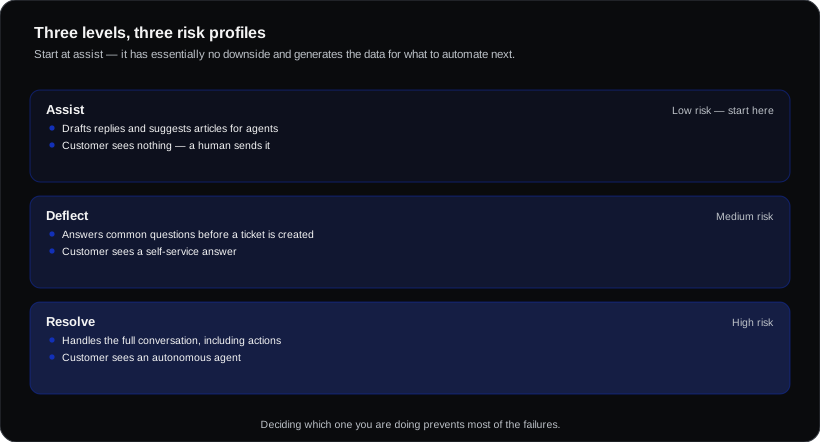
| Level | What it does | Customer sees | Risk if wrong |
|---|---|---|---|
| Assist | Drafts replies and suggests articles for agents | Nothing — a human sends it | Low |
| Deflect | Answers common questions before a ticket is created | A self-service answer | Medium |
| Resolve | Handles the full conversation, including actions | An autonomous agent | High |
Start at assist. It improves quality and speed immediately, has essentially no customer-facing downside, and — critically — generates the data showing which questions are worth automating at the next level.
What to automate first
Pull your last 1,000 tickets and group them. Nearly every support operation finds the same shape: a small number of question types account for a large share of volume.
Good first candidates share four traits:
- High volume, low variation — "where is my order", "how do I reset my password"
- Answerable from documentation you already have and trust
- Low consequence if imperfect — no billing changes, no account deletion, no safety implications
- Easy escalation to a human
Poor candidates: billing disputes, complaints, anything involving vulnerable customers, cancellations, safety issues, and anything where the answer depends on judgement about an individual's circumstances.
The honest economics
Vendors quote deflection rates of 50%+. Realistic outcomes for a well-implemented deployment on a decent knowledge base tend to land lower, and the number depends almost entirely on content quality rather than model quality.
| Cost element | Typical |
|---|---|
| AI resolution pricing | Often ~£0.70–1.00 per resolved conversation (Intercom Fin popularised this model) |
| Per-agent AI assist add-ons | £15–40 per agent/month |
| Knowledge base work | The real cost — usually weeks of someone's time |
That last row is the one budgets omit. An AI support agent is only as good as the content behind it. If your help centre is out of date, the fastest route to better AI support is a content project, not a software purchase.
Tooling
| Platform | Best for |
|---|---|
| Intercom (Fin) | Strong resolution quality; per-resolution pricing |
| Zendesk AI | Large existing Zendesk estates |
| Freshdesk / Freddy | Mid-market, cost-sensitive |
| HubSpot Service Hub | Already on HubSpot |
| Salesforce Agentforce | Already on Salesforce; deeper action-taking |
If you already run a helpdesk, evaluate its native AI first. The integration and data advantage usually outweighs a better standalone product.
Designing the handover
The handover to a human is where customer experience is won or lost, and it is consistently under-designed.
- Always offer an escape. A visible route to a person, on every response.
- Escalate on repetition. If the customer rephrases the same question twice, hand over — do not loop.
- Detect frustration and complaints and escalate immediately rather than attempting resolution.
- Pass the full context. Nothing annoys a customer more than repeating everything to the human.
- Never pretend to be human. Disclose that it is an AI agent — this is both an EU AI Act transparency expectation and simply better practice.
What to measure
Deflection rate alone is a misleading metric — it goes up when customers give up.
| Measure | Why |
|---|---|
| Resolution rate | Did the customer actually get their answer |
| CSAT split by AI-handled vs human-handled | Are AI conversations worse? |
| Escalation rate and reason | Where the content gaps are |
| Repeat contact within 7 days | The real test of whether it was resolved |
| Agent time per ticket | Whether assist is working |
| Wrong-answer rate | Sample and review manually; nothing else catches this |
Sampling actual conversations weekly is the single most valuable habit. Aggregate metrics hide confident wrong answers.
A twelve-week plan
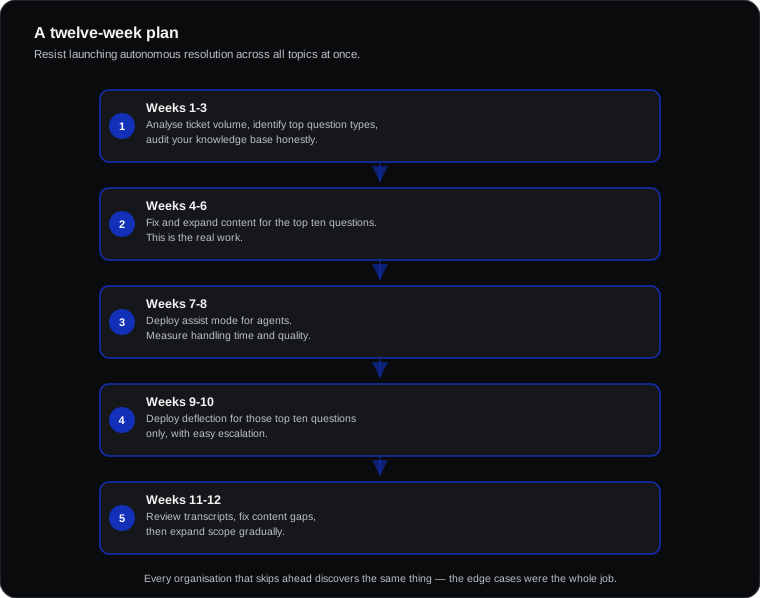
- Weeks 1–3: analyse ticket volume, identify the top question types, audit your knowledge base honestly.
- Weeks 4–6: fix and expand content for the top ten questions. This is the real work.
- Weeks 7–8: deploy assist mode for agents. Measure handling time and quality.
- Weeks 9–10: deploy deflection for those top ten questions only, with easy escalation.
- Weeks 11–12: review transcripts, fix content gaps, then expand scope gradually.
Resist launching autonomous resolution across all topics at once. Every organisation that does this discovers the same thing — the edge cases were the whole job.
Frequently asked questions
Will this let us reduce the support team?
Sometimes, but the more common and more valuable outcome is handling growth without adding headcount, and freeing agents for complex work. Plan for the second; treat the first as a bonus.
What if it gives a wrong answer?
It will. Design for it: clear disclosure that it is AI, easy escalation, transcript review, and never automating anything where a wrong answer causes real harm.
Do we have to tell customers it is AI?
Yes — and you should. Transparency for AI systems interacting with people is an explicit EU AI Act expectation, and attempting to pass off a bot as a person damages trust when discovered.