


Read this part before choosing any tool
Recruitment is one of the few areas where AI use is explicitly high-risk under the EU AI Act. Systems used for recruitment, candidate selection, and decisions on promotion or termination fall into the high-risk category, which brings substantial obligations: risk management, data governance, human oversight, transparency, accuracy testing and record keeping.
Separately, New York City's Local Law 144 requires annual bias audits for automated employment decision tools, and the UK ICO has published specific guidance on AI in recruitment.
The practical consequence for an agency: AI that helps a recruiter work faster is straightforward. AI that ranks, scores or filters candidates is a regulated activity. Nearly all the safe value is in the first category.
Where AI genuinely helps an agency
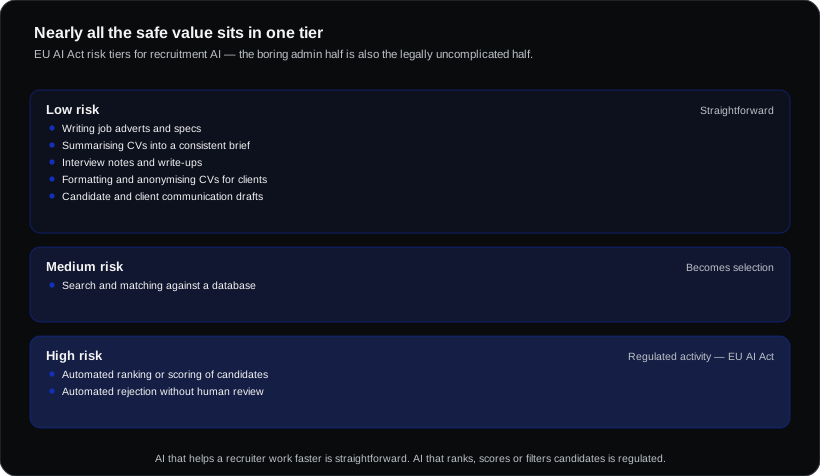
| Workflow | AI value | Risk level |
|---|---|---|
| Writing job adverts and specs | High — fast, and improves inclusivity of language | Low |
| Summarising CVs into a consistent brief | High — saves real time per candidate | Low, if no scoring |
| Interview notes and write-ups | High — removes the admin recruiters hate | Low |
| Formatting and anonymising CVs for clients | High — genuine hours saved | Low |
| Candidate and client communication drafts | Medium — good first drafts, needs a human pass | Low |
| Search and matching against a database | Medium — better recall than keyword search | Medium — becomes selection |
| Automated ranking or scoring of candidates | Contested — this is the regulated activity | High |
| Automated rejection without human review | Avoid | High |
The honest summary: the boring administrative half of recruitment is where AI pays, and it is also where it is legally uncomplicated.
The admin that AI removes well
Agency recruiters typically lose a large share of their week to work that is necessary but not skilled: reformatting CVs into house templates, writing up interview notes, drafting job specs from a client call, updating the CRM after every interaction, and writing similar candidate update emails repeatedly.
Automating that reliably returns hours per recruiter per week and requires no risky decision-making. Start there — it is the fastest payback and the easiest sell internally.
If you do use matching or ranking
If you deploy anything that influences which candidates progress, you take on real obligations:
- Keep a human decision-maker who reviews and can override, and who has the information and authority to do so meaningfully. Rubber-stamping is not oversight.
- Tell candidates that AI assists in the process, in your privacy notice and ideally at application.
- Test for bias across protected characteristics, and repeat it. Ask the vendor for their audit results and read the methodology.
- Document the system — purpose, data, model, testing, oversight arrangements.
- Retain records of decisions and the basis for them.
- Be able to explain a decision to a candidate who asks. If you cannot explain why someone was filtered out, you have a problem regardless of the technology.
Ask vendors directly: what data was this trained on, what bias testing has been done, can we see the audit, and what happens when it is wrong? Vague answers are disqualifying.
Tooling
| Need | Options |
|---|---|
| ATS/CRM with built-in AI | Bullhorn, Vincere, JobAdder, Recruit CRM |
| Sourcing and enrichment | SeekOut, hireEZ, LinkedIn Recruiter |
| Interview notes | Fathom, Fireflies, Metaview (recruitment-specific) |
| General drafting and summarising | ChatGPT Business, Copilot, Claude — cheapest and most flexible |
Many agencies find the general assistant plus a note-taker delivers most of the benefit before any specialist recruitment AI is purchased. Try that combination first; it is a tenth of the cost of a platform migration.
Data protection specifics
Candidate data is personal data, often including sensitive information, held for long periods and shared with third parties. Getting this right matters more in recruitment than in most sectors.
- Business-tier AI tools only — never paste CVs into a consumer account
- DPA in place with every tool that touches candidate data
- Retention limits actually enforced in the ATS, not just written in policy
- Candidates informed about AI use and about data sharing with clients
- Clear position on whether client data may be used to improve any model
A sensible sequence
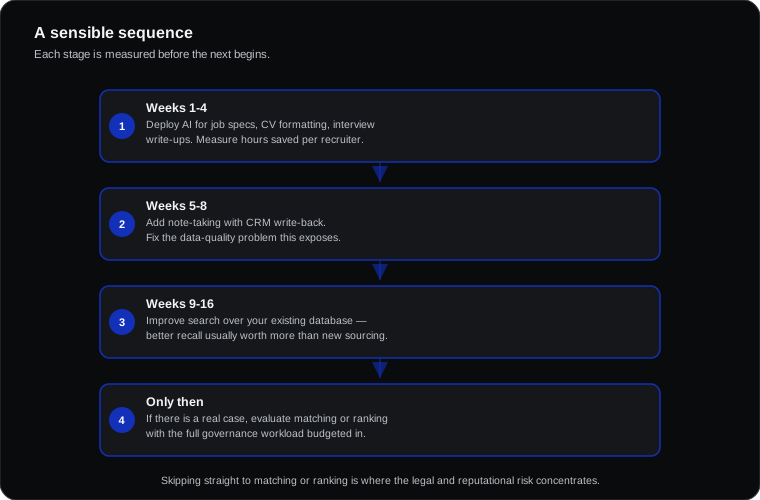
- Weeks 1–4: deploy AI for job specs, CV formatting and interview write-ups. Measure hours saved per recruiter.
- Weeks 5–8: add note-taking with CRM write-back. Fix the data-quality problem this exposes.
- Weeks 9–16: improve search over your existing database — better recall on candidates you already have is usually worth more than new sourcing.
- Only then, if there is a real case, evaluate matching or ranking with the full governance workload above budgeted in.
Frequently asked questions
Will AI replace recruiters?
It removes administrative volume. The parts clients actually pay for — judgement, persuasion, negotiation, relationship — are the parts AI is worst at. Agencies that redeploy the saved time into candidate contact tend to do well.
Can we let AI reject candidates automatically?
Legally and reputationally, don't. Under the EU AI Act this sits squarely in high-risk territory, and it is the single most likely thing to produce a discrimination claim.
Do candidates need to be told?
Yes. Transparency is required under GDPR and reinforced by the AI Act. It is also simply better practice — candidates increasingly ask.