


Define the journeys before you look at products
Marketing automation demos are compelling and almost entirely unhelpful for selection, because every platform demos well. The decision becomes tractable only once you can state, concretely:
- Which journeys you will actually build in the first six months
- Who will build and maintain them
- Where customer data lives and which system is authoritative
- What you will measure
Teams that cannot answer these buy on feature breadth, build three campaigns, and abandon the platform within a year while continuing to pay for it.
Platform positioning
| Platform | Best fit | Watch out for |
|---|---|---|
| HubSpot Marketing Hub | SMB to mid-market; marketing-led teams | Marketing contact pricing escalates as your database grows |
| Salesforce Marketing Cloud | Enterprise, complex segmentation, existing Salesforce | Significant implementation effort; specialist skills needed |
| Marketo (Adobe) | Enterprise B2B demand generation | Steep learning curve; needs dedicated ops |
| ActiveCampaign | SMB, strong automation for the price | Less strong for complex B2B attribution |
| Klaviyo | Ecommerce, especially Shopify | Built for ecommerce; weaker for B2B |
| Braze | Mobile-first, high-volume lifecycle | Enterprise pricing and complexity |
| Customer.io | Product-led SaaS, event-driven messaging | Requires engineering involvement |
| Mailchimp | Simple email marketing | Outgrown quickly by real automation needs |
The two questions that narrow it fastest
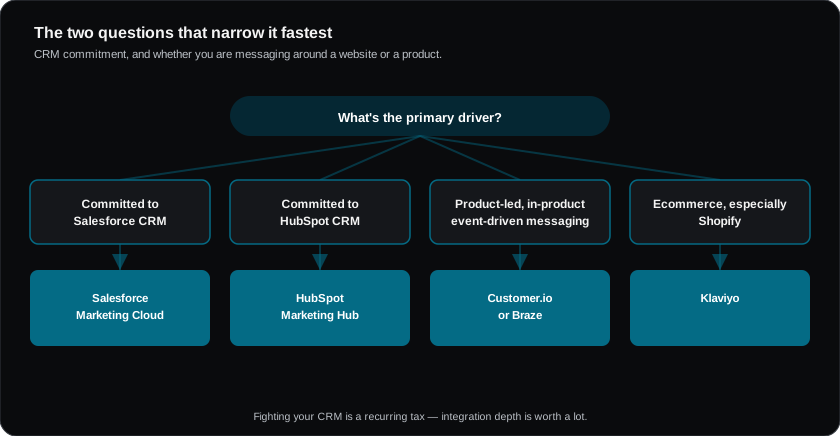
Is your customer data in a CRM you are committed to? If you are firmly on Salesforce, Marketing Cloud or a strong Salesforce-native option reduces integration pain considerably. If you are on HubSpot CRM, Marketing Hub is the path of least resistance. Fighting your CRM is a recurring tax.
Is your product a website or a product? Behaviour-triggered messaging based on in-product events (Customer.io, Braze) is a different category from campaign-and-nurture marketing (HubSpot, Marketo). Product-led SaaS companies frequently buy the wrong one of these.
Pricing models — read carefully
The models differ enough to change the ranking:
- Per marketing contact (HubSpot): scales with database size. Model three years of list growth, and note that unengaged contacts still cost money — which makes list hygiene a financial discipline, not just a deliverability one.
- Per email volume (Mailchimp, others): scales with sending frequency.
- Per monthly tracked user (Customer.io, Braze): scales with product usage.
- Flat licence plus services (Marketo, Marketing Cloud): high fixed cost, less variable exposure.
Model your actual expected growth against each. The cheapest platform at signup is frequently not the cheapest at year three, and the differences can be large.
Consent and data protection
For European operations this is a selection criterion, not an afterthought:
- Consent capture and storage, with proof of what was consented to and when
- Preference centre — granular, not just unsubscribe-everything
- Suppression lists honoured across every channel and every integration
- Deletion on request, including from backups and analytics
- Data location for the platform and its sub-processors
- DPA in place
Suppression across systems is the one that most often fails in practice. If someone unsubscribes in the marketing platform and still receives sequenced email from the sales tool, you have a compliance problem and an angry customer.
The resourcing question nobody asks early enough
Marketing automation platforms need an operator. Not a champion who is enthusiastic in month one, but someone whose job includes maintaining journeys, data hygiene, deliverability and reporting.
Under-resourcing here is the most common cause of failure — more common than choosing the wrong platform. A simpler tool that is well-run beats a sophisticated one that nobody maintains, every time.
A sensible selection process
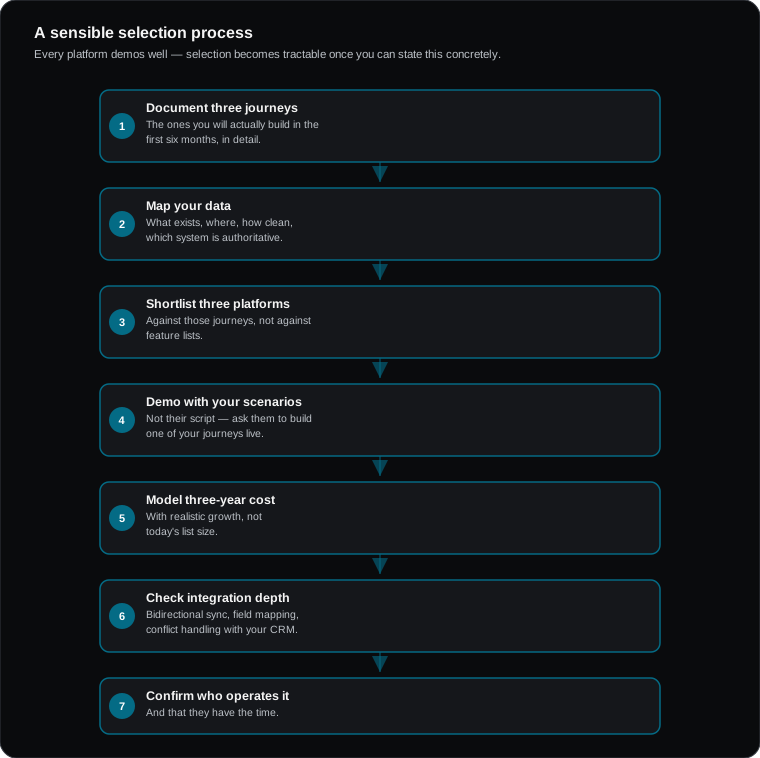
- Document three journeys you will build first, in detail
- Map your data — what exists, where, how clean, which system is authoritative
- Shortlist three platforms against those journeys, not against feature lists
- Demo with your scenarios, not their script. Ask them to build one of your journeys live
- Model three-year cost with realistic growth
- Check integration depth with your CRM specifically — bidirectional sync, field mapping, conflict handling
- Confirm who operates it and that they have the time
Frequently asked questions
Should we buy the platform our CRM vendor sells?
Often, yes — integration depth is worth a lot and the failure mode of a poorly-synced marketing platform and CRM is severe. Only look elsewhere if there is a specific capability gap that genuinely matters.
How long does implementation take?
SMB platforms, weeks. Enterprise platforms with data migration and complex journeys, three to six months. Both take longer if your data needs cleaning first, which it usually does.
Can AI features replace the operator?
They reduce the drafting workload. They do not maintain data quality, deliverability, consent records or journey logic — which is where the operator's time actually goes.