

Map the tools to the sales motion, not the hype
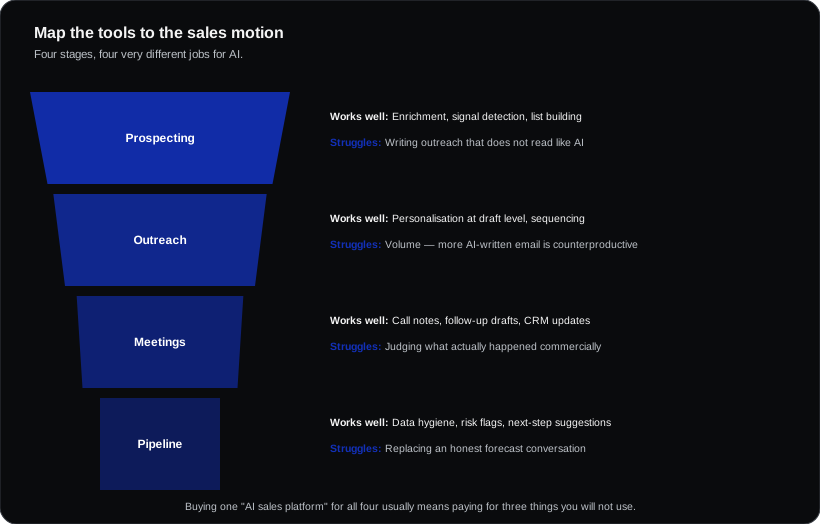
B2B sales has four distinct stages where AI helps in genuinely different ways. Buying one "AI sales platform" for all of them usually means paying for three things you will not use.
| Stage | The actual bottleneck | What AI does well here | What it does badly |
|---|---|---|---|
| Prospecting | Finding accounts worth the effort | Enrichment, signal detection, list building | Writing outreach that does not read like AI |
| Outreach | Getting a reply | Personalisation at draft level, sequencing, timing | Volume — more AI-written email is actively counterproductive |
| Meetings | Preparation and recall | Call notes, follow-up drafts, CRM updates | Judging what actually happened commercially |
| Pipeline management | Knowing which deals are real | Data hygiene, risk flags, next-step suggestions | Replacing an honest forecast conversation |
The category map
| Category | Representative tools | Typical price | Worth it when |
|---|---|---|---|
| Data and enrichment | Apollo, ZoomInfo, Clay, Cognism | £40–100+/user/mo (Cognism strong for EU data) | Your CRM data is stale or thin |
| Conversation intelligence | Gong, Chorus, Fathom, Fireflies | £0–100+/user/mo | You have enough calls for patterns to be meaningful |
| CRM-native assistants | Salesforce Agentforce, HubSpot Breeze | Bundled or add-on | You are already committed to that CRM |
| Sequencing and engagement | Outreach, Salesloft, Apollo | £60–120/user/mo | You run structured multi-touch motions |
| General assistant | ChatGPT, Copilot, Claude | £15–25/user/mo | Always — cheapest per unit of value for research and drafting |
What actually moves numbers
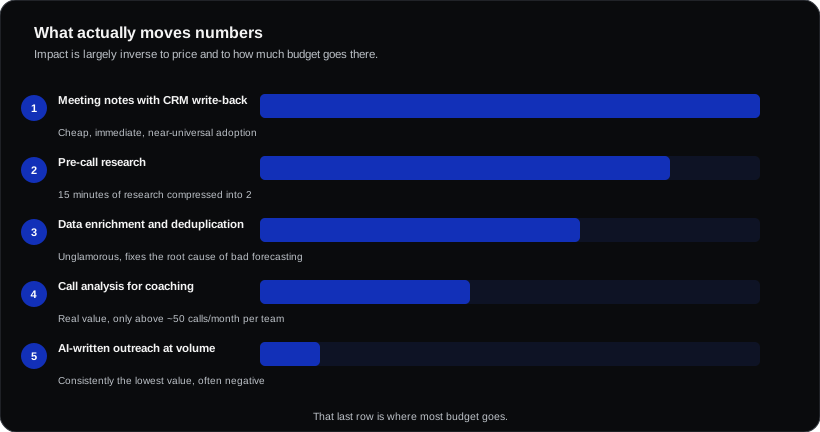
Having watched a lot of these deployments, the ranking of impact is fairly consistent and largely inverse to price:
- Meeting notes with CRM write-back. Removes the admin that reps genuinely hate and that silently destroys pipeline data quality. Cheap, immediate, near-universal adoption.
- Pre-call research. Fifteen minutes of manual research compressed into two. Reps arrive better prepared, which shows.
- Data enrichment and deduplication. Unglamorous, and it fixes the root cause of most bad forecasting.
- Call analysis for coaching. Real value, but only above a meaningful call volume — below roughly 50 calls a month per team the patterns are noise.
- AI-written outreach at volume. Consistently the lowest value and often negative. Prospects now recognise the format instantly, and reply rates on obviously-generated sequences have fallen sharply.
That last point deserves emphasis because it is where most budget goes. AI's advantage in outreach is research depth per message, not messages per hour.
The European wrinkle
Prospecting data is where EU sales teams get into trouble. Under GDPR, scraping and enriching contact data has a lawful basis question, and several enforcement actions have targeted exactly this. Practical guardrails:
- Prefer vendors with a documented EU-compliant data sourcing model — Cognism in particular markets on this basis
- Honour opt-outs across every tool, not just the one that received them
- Include the required transparency information in first contact
- Do not import personal data into a general AI assistant that lacks a DPA
For a ten-person sales team
A defensible stack, roughly £120–150 per user per month all in:
- Meeting notes with CRM sync — the highest-return line item
- General AI assistant for research and drafting
- One enrichment source, chosen for regional data quality
- CRM-native AI if already included in your licence
Add conversation intelligence when call volume justifies it. Add a dedicated sequencing platform only if you genuinely run structured outbound at scale — for many mid-market teams the CRM's built-in sequencing is sufficient.
Frequently asked questions
Does AI-generated outreach still work?
Templated, obviously-generated sequences work notably less well than they did. Using AI to research deeply and write fewer, better, genuinely specific messages does work.
Should we buy an all-in-one platform?
Only if you will use most of it. Most teams get more from a strong CRM plus two or three focused tools than from a broad platform used at 20% of its capability.
How do we measure it?
Meetings booked per rep, pipeline created, CRM data completeness and time spent on admin. Not licences deployed, and not rep sentiment alone.