


Agency software is a different product category
The most expensive mistake in staffing software selection is evaluating corporate ATS products. An internal HR team hires for one employer. An agency runs two marketplaces at once — candidates and clients — plus, in contract staffing, a payroll and margin operation underneath.
That means an agency system needs things a corporate ATS simply does not have:
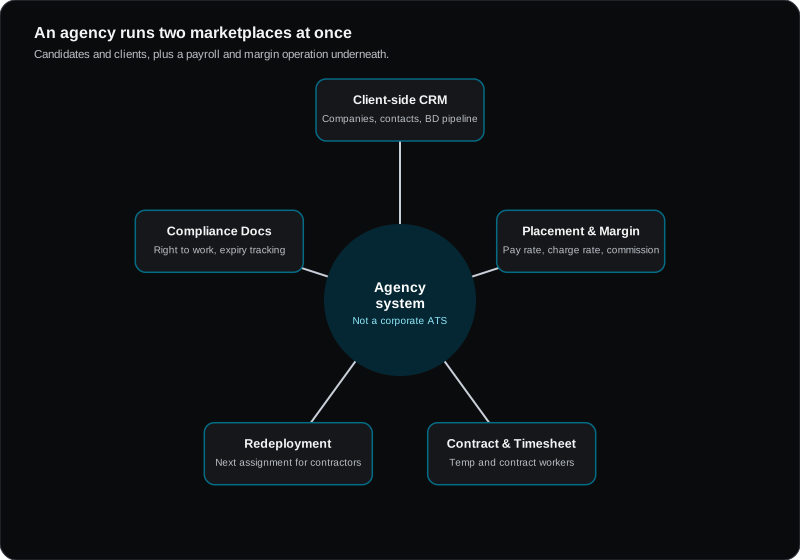
- Client-side CRM, not just candidate tracking — companies, contacts, vacancies, business development pipeline
- Placement and margin tracking — pay rate, charge rate, margin, and who owns the commission
- Contract and timesheet management for temporary and contract workers
- Redeployment — finding your existing contractors their next assignment
- Compliance documentation — right to work, certifications, expiry tracking
The platform landscape
| Platform | Best fit | Notes |
|---|---|---|
| Bullhorn | Mid-market to enterprise agencies | Market leader, deepest ecosystem, correspondingly priced |
| Vincere | Mid-market, strongly perm and exec search | Modern interface, strong reporting |
| JobAdder | SMB to mid-market | Straightforward, good integrations, easier adoption |
| Recruit CRM | Small agencies and search firms | Strong price-performance, quick to deploy |
| Mercury (on Dynamics) | Agencies already in the Microsoft stack | Inherits Dynamics extensibility |
| Loxo | Search-led and sourcing-heavy firms | Strong sourcing and outreach emphasis |
Choose by your service model, not agency size
| Your model | What matters most |
|---|---|
| Permanent placement | Candidate pipeline, client CRM, interview scheduling, offer tracking |
| Contract / temp | Timesheets, rate and margin, compliance expiry, back-office or payroll integration |
| Executive search | Long-cycle project management, research, mapping, confidential handling |
| RPO / MSP | Multi-client segregation, client-specific workflows, SLA reporting |
| Mixed | Genuine dual capability — many products claim it and only do one properly |
Contract staffing is where the wrong choice hurts most. If half your revenue is temp and your system cannot handle timesheets and margin natively, you will run a parallel spreadsheet operation forever.
The part that actually determines success
Recruiter adoption, and it is almost always decided by how many clicks it takes to log an interaction. A recruiter making sixty contacts a day will not use a system that takes ninety seconds to record each one — they will keep it in their head and in their inbox, and your database will rot.
Test this specifically in evaluation: have an actual recruiter, not a manager, complete a full day's typical activity in a trial environment and count the friction. Email and calendar integration quality matters more here than any feature on the comparison sheet.
Data migration is the project
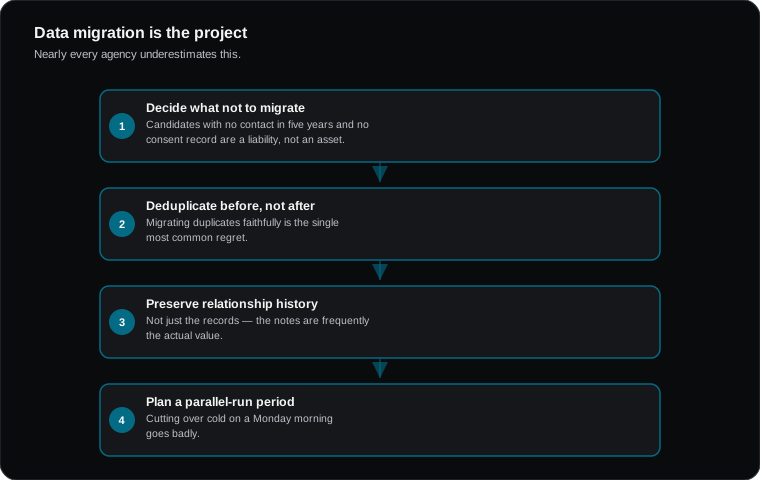
Nearly every agency underestimates this. You will be migrating years of candidates, clients, contacts, vacancies, placements and notes — much of it duplicated, out of date, or attached to people who have left.
- Decide what not to migrate. Candidates with no contact in five years and no consent record are a liability, not an asset.
- Deduplicate before, not after. Migrating duplicates faithfully is the single most common regret.
- Preserve the relationship history, not just the records — the notes are frequently the actual value.
- Plan a parallel-run period. Cutting over cold on a Monday morning goes badly.
Compliance, especially in Europe
Candidate data is personal data held long-term and shared with third parties. Agencies carry more exposure here than most businesses:
- Retention with actual enforcement. A policy saying two years, with a database holding fifteen, is worse than no policy.
- Consent and lawful basis recorded per candidate, and portable across the migration.
- Right-to-work and certification expiry tracked and alerted.
- AI features assessed separately. Anything that ranks or filters candidates is high-risk under the EU AI Act — see AI automation for recruitment agencies.
Frequently asked questions
Can we run on a general CRM like HubSpot or Salesforce?
Some agencies do, usually with a recruitment overlay. It works better for search and perm than for contract, where timesheet and margin handling is hard to replicate well.
How long should implementation take?
Small agency, weeks. Mid-market with contract operations and data migration, three to six months realistically. Vendors quoting materially less are usually excluding your data migration.
What is the most-regretted decision?
Choosing on feature list rather than recruiter usability, then discovering six months later that the team is working around the system instead of in it.