


Pick the platform before the certification
Cloud certifications are platform-specific, so the first decision is not which exam to sit — it is which cloud your target employers actually run. Getting this wrong wastes months.
| Platform | 2026 market share | Approx. active job postings | Notes |
|---|---|---|---|
| AWS | ~30–32% | Largest volume globally | Deepest job market, also the most crowded candidate pool |
| Microsoft Azure | ~23–25% | Strong, enterprise-weighted | Dominant where Microsoft 365 already exists; heavy UK/EU public sector and finance presence |
| Google Cloud | ~11–13% | Smallest of the three | Fewest certified engineers, so scarcity can push pay up, especially around BigQuery and data/AI work |
A practical rule: check twenty real job adverts in your city or target market and count the platform mentions. That local count matters far more than global market share.
The five tracks
Every major cloud offers roughly the same ladder. Choose the track that matches the job you want, not the one with the most impressive title.
| Track | What the job is | AWS | Azure | Google Cloud |
|---|---|---|---|---|
| Foundations | Vocabulary and billing basics | Cloud Practitioner | AZ-900 | Cloud Digital Leader |
| Architect | Designs systems, makes trade-offs | Solutions Architect Associate → Professional | AZ-104 → AZ-305 | Professional Cloud Architect |
| Engineer / Ops | Builds and runs infrastructure, automation | SysOps Administrator | AZ-104 | Professional Cloud DevOps Engineer |
| Developer | Writes cloud-native application code | Developer Associate | AZ-204 | Professional Cloud Developer |
| Security | Identity, network, workload protection | Security Specialty | AZ-500 | Professional Cloud Security Engineer |
| Data / AI | Pipelines, warehousing, ML platform | Data Engineer / ML Specialty | DP-203 / AI-102 | Professional Data Engineer / ML Engineer |
Where to start, by background
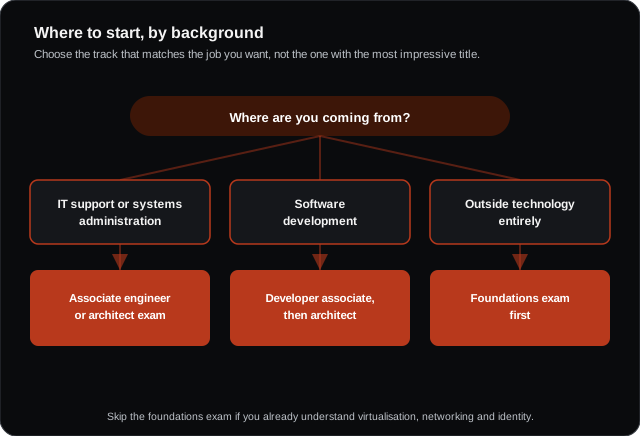
Coming from IT support or systems administration: start with the associate-level engineer or architect exam (AZ-104 or AWS Solutions Architect Associate). Skip the foundations exam if you already understand virtualisation, networking and identity — it will not add much to your CV.
Coming from software development: go straight to the developer associate exam, then add the architect associate. Your gap is usually networking and IAM, not code.
Coming from outside technology entirely: do take the foundations exam. It is cheap, gives you the vocabulary, and confirms you actually enjoy the subject before you spend more.
Realistic preparation time
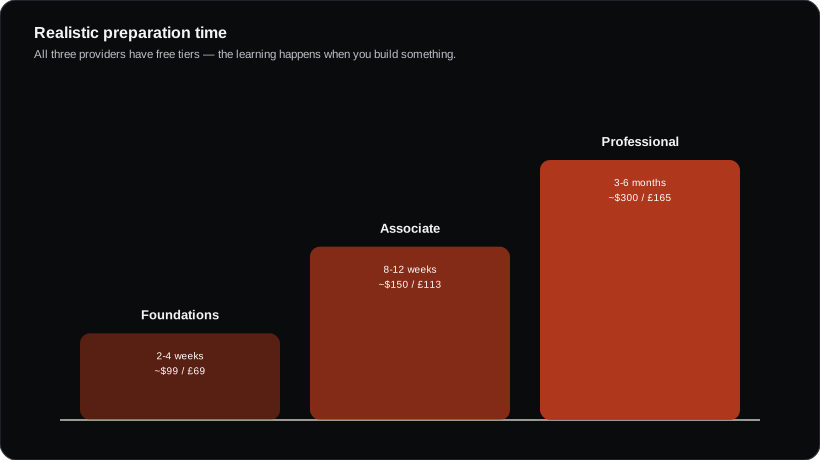
| Level | Study time (part-time) | Typical exam cost |
|---|---|---|
| Foundations | 2–4 weeks | $99 / £69 |
| Associate | 8–12 weeks | $150 / £113 |
| Professional / Expert | 3–6 months | $300 / £165 |
| Specialty | 2–4 months | $300 |
These assume a few hours per week and, critically, hands-on time. All three providers have free tiers — the learning happens when you build something and get billed for leaving it running, not when you watch a video.
Where to learn
- AWS Skill Builder — official free tier including exam-prep courses
- Microsoft Learn — genuinely comprehensive and completely free, with sandbox environments
- Google Cloud Skills Boost — official labs, some free credits
- Free tiers: AWS Free Tier, Azure free account, Google Cloud free tier
Microsoft Learn is the strongest free official resource of the three. If cost is a constraint, the Azure path is the cheapest to learn on.
What certifications do and do not do
They reliably get you past CV screening and HR filters, and they matter more for consultancies and partners — many hold partner-tier requirements that are literally counted in certified staff, so consultancies will often fund and sometimes require them.
They do not demonstrate that you can debug a production incident, size a workload sensibly or explain a cost trade-off to a finance director. Build one real project — a small application deployed with infrastructure-as-code, monitoring and a documented cost estimate — and you will interview better than someone with three more certifications.
Frequently asked questions
Should I learn more than one cloud?
Not at the same time, and not early. Go deep on one to associate or professional level first. Concepts transfer more easily than most people expect once the first platform is solid.
Do certifications expire?
Yes. AWS and Google Cloud certifications last two years; Microsoft role-based certifications renew annually through a free online assessment. Factor renewal effort into how many you hold.
Is the AI/ML specialisation worth it?
Increasingly, yes — Azure OpenAI and AWS SageMaker skills are among the fastest-rising demands. But they sit on top of solid cloud fundamentals; they are a poor entry point.