


Three layers, three very different commitments
"AI in Salesforce" now covers three distinct things with very different cost and effort profiles. Knowing which you are buying prevents most disappointment.
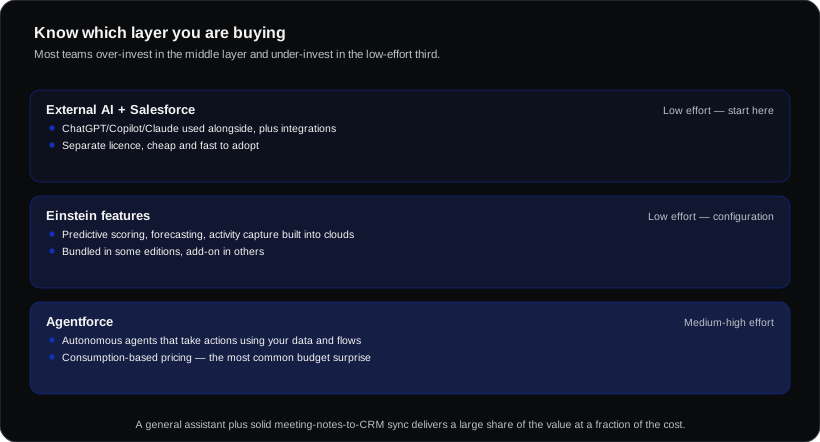
| Layer | What it is | Effort | Licensing |
|---|---|---|---|
| Einstein features | Predictive scoring, forecasting, activity capture built into clouds | Low — configuration | Bundled in some editions, add-on in others |
| Agentforce | Autonomous agents that take actions using your data and flows | Medium to high | Consumption-based pricing |
| External AI + Salesforce | ChatGPT/Copilot/Claude used alongside, plus integrations | Low | Separate licence |
Most teams over-invest in the middle layer and under-invest in the third. A general assistant plus solid meeting-notes-to-CRM sync delivers a large share of the practical value at a fraction of the cost and effort.
Where AI genuinely helps a Salesforce team
Data quality — the highest-value and least glamorous. Salesforce's value is a function of data completeness, and reps hate data entry. Automatic activity capture and AI-generated call summaries written back to the record fix the root cause of bad forecasting. If you do one thing, do this.
Call and meeting summarisation into the opportunity record. Removes admin, improves handovers, and makes pipeline reviews based on evidence rather than recollection.
Email and follow-up drafting in context. Good first drafts grounded in the account history.
Opportunity scoring and risk flags. Genuinely useful, but only once you have enough closed-won and closed-lost history for the model to learn from. Below a few hundred closed opportunities, treat the scores sceptically.
Service case deflection and agent assist. Often the strongest Agentforce use case, because support questions are repetitive and well-documented.
Where it disappoints
- Forecasting accuracy without clean data. AI cannot fix a pipeline where close dates are fiction — it will confidently extrapolate the fiction.
- Autonomous outbound. Same problem as elsewhere: prospects recognise generated sequences.
- Complex quoting logic. Deterministic rules beat probabilistic generation for anything with contractual consequences.
- Replacing a real pipeline conversation. Risk flags prompt the conversation; they do not substitute for it.
Agentforce, realistically
Agentforce is capable and genuinely different from earlier Einstein features — agents can reason over your data and take actions through flows and Apex. The considerations before committing:
- Consumption pricing. Costs scale with usage rather than seats. Model expected volume carefully and set limits; this is the most common source of budget surprise.
- It is only as good as your data and flows. An agent invoking a broken process executes the broken process reliably.
- Grounding needs real work. Data Cloud and well-maintained knowledge articles are the substance behind agent quality.
- Start with service, not sales. Support deflection is more bounded, more measurable and lower-risk than autonomous selling.
A pragmatic sequence
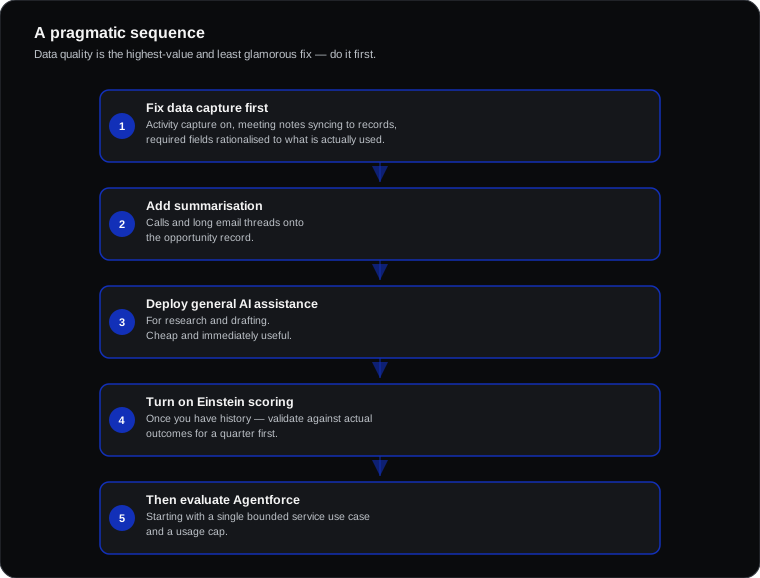
- Fix data capture first. Activity capture on, meeting notes syncing to records, required fields rationalised to what is actually used.
- Add summarisation — calls and long email threads onto the opportunity.
- Deploy general AI assistance for research and drafting. Cheap and immediately useful.
- Turn on Einstein scoring once you have history, and validate it against actual outcomes for a quarter before letting it influence process.
- Then evaluate Agentforce, starting with a single bounded service use case and a usage cap.
Governance that matters
- Field-level security applies to AI too. Confirm that generated summaries do not surface data the user should not see.
- Personal data in prompts. Use of external AI tools with Salesforce data needs a DPA and business-tier terms.
- Keep humans on customer-affecting output — quotes, commitments, contractual language.
- Audit generated content periodically. Sampling catches confident errors that aggregate metrics hide.
Frequently asked questions
Is Agentforce worth it for a mid-sized team?
Sometimes — usually for service before sales. The prerequisite is decent data and documented processes. Without those, spend the budget on data quality first; the return is higher and more certain.
Does Salesforce train on our data?
Salesforce's Einstein Trust Layer is designed so customer data is not retained by or used to train third-party models. Verify the specifics for the features you enable.
Can we use ChatGPT or Copilot with Salesforce instead?
Yes, and for many teams it is the better starting point — cheaper, faster to adopt, no platform project. The trade-off is less native grounding in Salesforce data.